
Rabby Browser Wallet in DeFi: How Its Safety Model Compares with MetaMask and Hardware Wallets
More than 140 supported EVM networks can make a wallet feel safer and more convenient at the same time. They can also make mistakes easier to repeat. That is the central tension behind Rabby: a multi-chain wallet can reduce operational friction, but convenience is not the same as security. For users in Germany and elsewhere in the German-speaking DeFi community, the important question is therefore not simply whether Rabby is a good alternative to MetaMask. It is whether its transaction simulation, risk warnings, chain management and signing options improve the decisions a user makes before value moves on-chain.
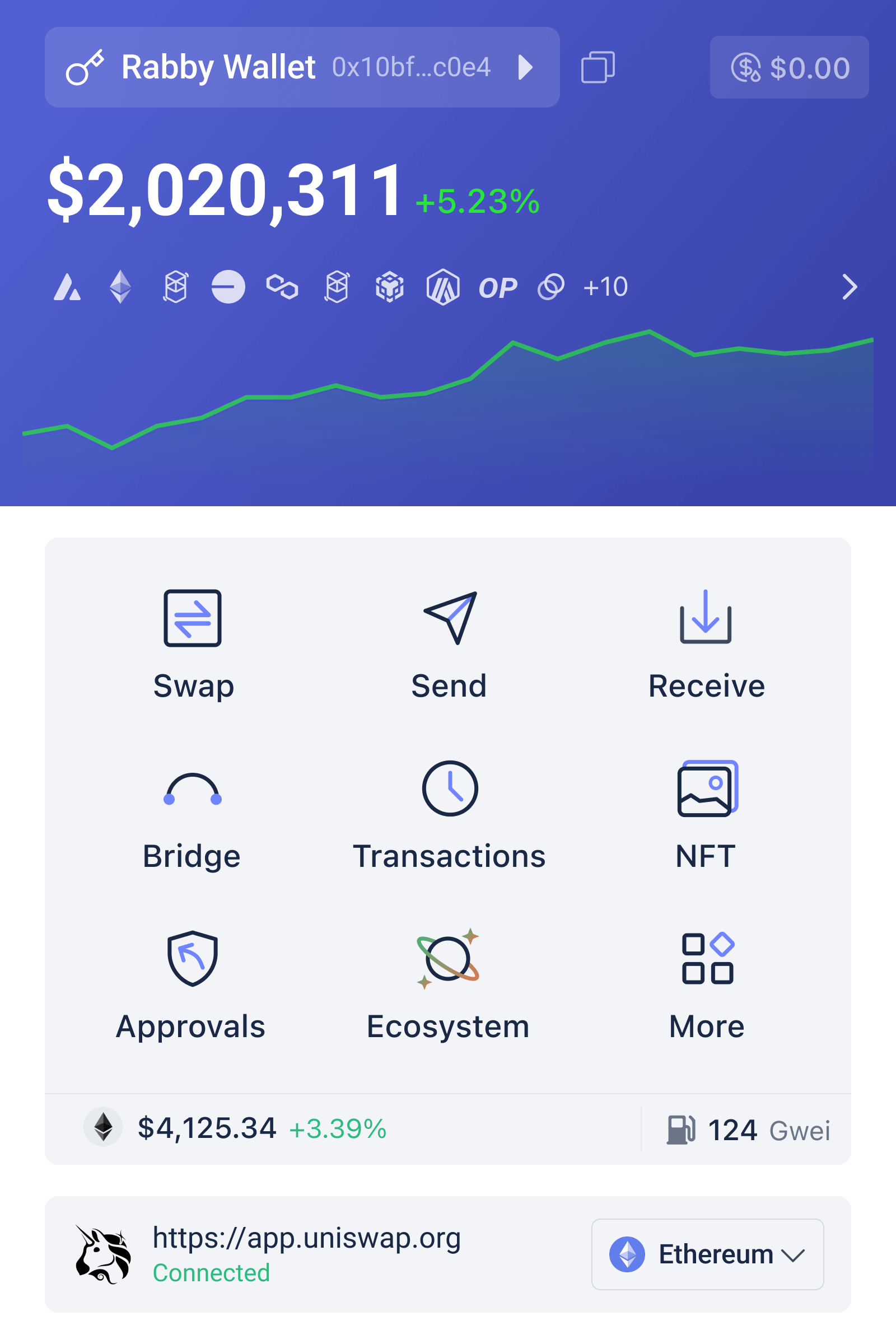
Rabby is a non-custodial wallet developed by DeBank for Ethereum and other EVM-compatible networks. Its design is aimed at people who interact with decentralised applications rather than merely holding tokens. The browser extension, desktop software and mobile applications provide access to networks such as Ethereum, Polygon, Arbitrum, Optimism, Avalanche, Base and BNB Chain. Yet the more useful way to understand Rabby is as a decision-support layer between a dApp and the user’s signing device.
What Rabby changes before a transaction is signed
A conventional wallet prompt often asks the user to approve a technical message or contract call. That information may be accurate, but it is rarely easy to interpret. Rabby adds a different layer: before signing, it simulates the proposed transaction and presents the expected changes to token balances. In practical terms, the user can compare the intended action with the likely result rather than relying only on the dApp’s interface.
This distinction matters because a blockchain transaction is not identical to the button that initiated it. A user may click “deposit”, “claim” or “swap”, while the underlying call includes approvals, contract interactions or asset transfers. Simulation does not eliminate this complexity, but it can translate part of it into a more useful question: what will leave my wallet, what may arrive, and which permissions am I granting?
Rabby’s integrated security engine adds checks for suspicious addresses, phishing indicators, known exploits and potentially unlimited token approvals. These warnings are valuable because DeFi risk frequently arises at the boundary between a legitimate wallet and an untrusted contract. Still, they are signals, not guarantees. A new attack may not yet be known, a contract can behave differently under changing conditions, and a simulation cannot predict every future action made possible by a permission.
The sharper mental model is therefore “second opinion”, not “automatic protection”. Rabby does not take custody of the private key, and its servers do not receive that key. The wallet can act as an independent verifier while the core signing process remains local. But the person controlling the key still decides whether to approve a transaction. If a warning is ignored, the underlying authority has not changed.
Rabby versus MetaMask: richer context versus familiar simplicity
MetaMask remains a widely recognised entry point into Ethereum and EVM DeFi. Its strength is familiarity: many dApps document its use, and experienced users often understand its account and network model. For a person who mainly uses a small number of established applications, that simplicity may be sufficient.
Rabby takes a more specialised position. It automatically detects the network required by a connected dApp and can switch to it, reducing manual chain configuration. It also places transaction simulation and risk analysis closer to the signing decision. For a user moving between Ethereum mainnet, Arbitrum, Base and other networks during a single research or trading session, this can reduce cognitive load and the chance of approving an action on the wrong chain.
The trade-off is that a more capable interface may encourage more activity. Integrated swaps, bridges and gas services make it easier to move assets, but they also compress several decisions into one wallet environment. Rabby can scan decentralised exchanges such as Uniswap and 1inch through its swap function, and it integrates bridge infrastructure such as LI.FI. That is convenient, but a route that appears optimal on price may still involve smart-contract, liquidity, counterparty or bridge-specific risks.
For German users, the practical implication is straightforward: a wallet interface should not replace records of what was done. Swaps, bridge transfers, gas payments and rewards may have different accounting and tax consequences depending on the individual situation. A clear transaction history and personal documentation remain necessary even when the wallet makes execution feel seamless.
Rabby versus a hardware wallet: not competitors, but different layers
Comparing Rabby with Ledger, Trezor or OneKey requires care. A hardware wallet protects the signing key by keeping it in a dedicated device. Rabby is primarily an interface and transaction-analysis environment. In fact, Rabby supports hardware wallets, allowing the two approaches to work together rather than forcing a choice between them.
This combination illustrates a useful security principle: analysis and authorisation are separate jobs. Rabby can show what a transaction is expected to do, while the hardware device provides an additional boundary before the signature is produced. For larger balances or long-term holdings, that separation can be more meaningful than choosing one browser extension over another.
Hardware signing also has limits. It does not make a malicious transaction harmless; a user can still confirm the wrong contract call on a hardware screen. Conversely, a clear Rabby simulation does not protect a device whose recovery phrase has been exposed. Wallet security is layered: software interpretation, user verification, key protection and operational discipline each address different failure modes.
Gas, swaps and bridges: where convenience becomes a risk variable
Rabby’s Gas Account allows users to pay network fees with stablecoins such as USDC across networks, even when they lack the native token required for gas. This solves a familiar onboarding problem. Someone holding assets on a chain may otherwise be unable to move them because the wallet contains no ETH, MATIC or other native fee asset.
However, abstracting gas changes the user’s mental model. Native tokens are not merely a nuisance; they are part of how a network prices and authorises computation. A stablecoin-based gas service may simplify access, but it introduces reliance on the service’s availability, supported routes and conversion conditions. The user should still confirm the final fee, the network and the asset being deducted.
The same principle applies to the integrated swap aggregator and cross-chain bridges. Scanning multiple venues can improve route selection and potentially reduce slippage, but “best rate” is never the same as “lowest total risk”. Price impact, execution failure, token approval scope, bridge security and settlement time all matter. A route with a slightly worse quoted price may be preferable if it uses fewer assumptions or a more familiar protocol.
How to install and use Rabby responsibly
Those searching for “Rabby installieren” should begin with source verification rather than speed. Use the official distribution channel for the relevant browser, desktop system or mobile platform, and check that the extension and application are genuine. The wallet is primarily available for Chrome, Brave and Edge, with desktop versions for Windows and macOS and mobile applications for iOS and Android.
During setup, the recovery phrase is the most important security object. It should never be entered into a website, shared with support or stored in an unencrypted cloud document. A wallet can be open source under the MIT licence and still be used unsafely if the recovery phrase is copied into a phishing page. Open source improves inspectability; it does not turn every user into an auditor or guarantee that surrounding infrastructure is risk-free.
For a new dApp, a disciplined workflow is more valuable than a long feature list. First verify the domain through an independent route. Then inspect the selected network, the contract address, the assets leaving the wallet and the permissions being granted. Read the simulation, review warnings and prefer limited approvals where appropriate. For a high-value transaction, use a hardware wallet and test with a small amount before committing more capital.
Readers who want a structured starting point can review this rabby wallet resource, while treating installation as a verification task rather than a simple download. The key question is not whether the interface looks familiar, but whether the source, permissions and signing flow are consistent with the intended action.
Where Rabby fits best—and where it may not
Rabby is a strong fit for active EVM users who move across several chains and want transaction outcomes explained before signing. Its simulation, automatic network selection, security scanner, integrated swaps and bridge access address the operational friction that grows as a user’s DeFi activity expands. Its compatibility with hardware wallets also makes it relevant for more cautious users who want a richer interface without abandoning isolated key storage.
It may be less suitable for someone who wants the smallest possible attack surface, rarely uses DeFi and prefers a dedicated hardware device with minimal software interaction. It is also not a universal wallet for every blockchain architecture: its broad support is concentrated on EVM-compatible networks. Finally, points and loyalty features may add engagement, but they should not influence a security decision. Rewards are not compensation for smart-contract or market risk.
Recent positioning in the Chrome Web Store continues to describe Rabby as an open-source browser wallet for Ethereum and EVM networks with a multi-chain DeFi focus. The forward-looking question is whether wallet interfaces can make complex transactions genuinely more understandable without encouraging overconfidence. If simulations become more precise and users learn to treat them as evidence rather than permission, the benefit could be substantial. If convenience simply accelerates unexamined approvals, the same interface may amplify activity without reducing risk.
FAQ
Is Rabby safer than MetaMask?
It can provide more transaction context, simulation and risk warnings, especially for multi-chain DeFi. That does not make it automatically safe. Both wallets remain dependent on the user protecting the recovery phrase, checking dApp addresses and rejecting suspicious approvals.
Can Rabby be used with a Ledger or Trezor?
Yes. Rabby supports hardware wallets including Ledger, Trezor and OneKey. Rabby can provide the interface and transaction analysis, while the hardware wallet retains the signing boundary.
Does transaction simulation guarantee that funds cannot be stolen?
No. Simulation shows the expected effects of a transaction under the available conditions, but it cannot guarantee future contract behaviour or identify every novel attack. Treat it as an important review tool, not as an insurance policy.
Can Rabby pay gas without the native token?
Its Gas Account function can allow fees to be paid with stablecoins such as USDC across supported networks. Users should still review availability, conversion terms, final costs and the exact asset being charged before confirming.