Why a Privacy Wallet Is More Than an “Anonymous Transaction” Button
The most privacy-conscious crypto users often make a counterintuitive mistake: they focus on the coin before they examine the wallet. Yet a privacy asset can still expose useful clues through addresses, device data, network connections, transaction timing, or careless backups. In other words, anonymity is not a single feature switched on at the moment a payment is sent. It is a system property created—or weakened—by the interaction between blockchain design, wallet software, user behavior, and the surrounding financial infrastructure.
That distinction matters in the United States, where a user may move between a regulated exchange, a self-custody wallet, a hardware device, and a merchant payment in the same week. Monero can provide stronger on-chain privacy than transparent blockchains, but it does not erase every record created before or after a transaction. Bitcoin can be managed securely, but its public ledger makes transaction relationships easier to analyze. A multi-currency privacy wallet tries to make these choices practical, while also introducing its own trade-offs.
What “anonymous” means on a blockchain
“Anonymous transactions” is convenient language, but it is technically imprecise. Most crypto systems do not make users anonymous in the ordinary sense. They replace names with cryptographic addresses, creating pseudonymity. If an address becomes associated with a person through an exchange account, a payment receipt, a public post, or reused identifying information, activity connected to that address may become easier to attribute.
Monero approaches the problem differently. Its protocol is designed to obscure important transaction relationships by default. Ring signatures make it difficult for an outside observer to determine which input was actually spent among a group of possible inputs. Stealth addresses help ensure that a recipient does not publish one reusable address that visibly receives every payment. Ring Confidential Transactions, commonly called RingCT, conceal the transferred amount while still allowing the network to verify that the transaction is valid and does not create money improperly.
The important mental model is not that Monero makes a transaction disappear. Rather, it changes what an observer can reliably infer from the public ledger. That is a meaningful distinction. A chain analyst may find the evidence less direct, but the user can still reveal information through network metadata, screenshots, wallet notifications, exchange records, or a compromised device. Protocol privacy reduces one category of exposure; it does not replace operational security.
Why the wallet still matters
A wallet is best understood as a key-management and transaction-construction environment, not a digital container holding coins. The assets remain recorded on a network; the wallet controls the credentials needed to authorize spending and, depending on the protocol, to inspect incoming funds. This makes the wallet’s security model central to privacy.
A well-designed Monero wallet should make address reuse less likely, protect sensitive keys, explain synchronization status, and avoid presenting privacy settings as decorative buttons. It should also make backups understandable. Monero’s view key and spend key have different functions, so a backup or sharing decision can have consequences beyond simple access to funds. A view-only arrangement, for example, may support monitoring without granting spending authority, but it is not equivalent to complete secrecy.
For users who hold Bitcoin alongside Monero, multi-currency support can reduce the temptation to install several unfamiliar applications. That convenience is real, but it creates a larger software surface: more code paths, more address formats, more network connections, and more opportunities for a mistaken transfer. A single interface does not necessarily mean a single security model. Each supported asset may have different fee logic, confirmation behavior, privacy properties, and recovery assumptions.
Before using any wallet, a cautious user should verify the download source, check the receiving address on the device screen when possible, test recovery with a small amount, and keep a backup that is offline and protected from unauthorized access. On a phone, screen locks and operating-system updates matter. On a desktop, malware and clipboard replacement are practical concerns. A privacy wallet cannot conceal a seed phrase typed into a phishing page.
Comparing the main approaches
Monero-first self-custody
A Monero-focused wallet is usually the clearest choice for someone whose primary requirement is private Monero payments. The advantage is conceptual consistency: the wallet can be designed around Monero’s address system, synchronization process, and privacy features rather than treating them as one asset among many. The cost is narrower coverage. Users who also need Bitcoin or other networks may have to manage a second wallet and learn a separate backup routine.
Multi-currency privacy wallets
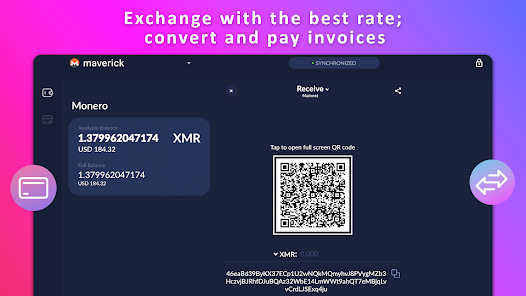
A multi-currency wallet is attractive when convenience and portfolio breadth matter. It can simplify day-to-day use, make it easier to exchange or organize different assets, and reduce application switching. For a user evaluating a multi-currency wallet, a practical starting point is the cake wallet download, followed by independent verification of the official source, supported networks, recovery process, and current security documentation.
The sacrifice is that “multi-currency” can encourage false equivalence. Bitcoin privacy is not Monero privacy. A wallet interface may look identical when the underlying ledger behavior is radically different. Bitcoin users should understand address types, change outputs, coin selection, and the consequences of linking transactions. A Bitcoin wallet can improve privacy through careful transaction construction, but it cannot provide Monero’s protocol-level default obfuscation.
Hardware wallets and custodial platforms
Hardware wallets are strong candidates for long-term storage because they can keep signing keys isolated from a general-purpose phone or computer. They are less convenient for frequent private payments, and compatibility with privacy-focused assets or advanced transaction features may vary. A hardware device protects keys; it does not automatically make the transaction graph private.
Custodial platforms are the simplest operationally: the provider manages keys, synchronization, and often recovery. They may also create the clearest identity link, because account verification and transaction records are part of the service relationship. For many Americans, regulated platforms are useful on-ramps and off-ramps, but they should not be confused with private self-custody. Convenience and privacy often pull in opposite directions at this layer.
The privacy boundary most users overlook
Privacy has at least three layers. The first is ledger privacy: what can be inferred from the blockchain itself. The second is endpoint privacy: what the wallet, phone, computer, browser, and backup reveal. The third is institutional privacy: what exchanges, payment processors, merchants, or other intermediaries can associate with a person.
Monero addresses the first layer strongly by design, but the other two remain. If a user buys crypto through an identity-verified service, sends it to a wallet, and later reports the transaction to a merchant or tax professional, the surrounding records can still establish context. That is not a failure of Monero; it is a boundary condition of privacy technology. A private ledger cannot undo information voluntarily disclosed elsewhere.
There is also a usability boundary. Stronger privacy often requires more synchronization time, more careful backup management, or less compatibility with common payment infrastructure. A wallet that hides complexity too aggressively may be easy to use but difficult to audit. Conversely, a technically transparent wallet may be safer for an experienced user and intimidating for everyone else. Good design must expose the decisions that matter without requiring every user to become a protocol engineer.
A reusable framework for choosing a privacy wallet
Start with the threat model rather than the feature list. Ask what you are trying to protect and from whom. If the concern is theft from a compromised laptop, hardware-backed signing may matter most. If the concern is public transaction tracing, the underlying asset and transaction practices matter more. If the concern is account identification by a service provider, self-custody alone may not solve the problem.
Next, separate privacy from recovery. A wallet can offer strong transaction privacy but poor recovery documentation. It can have excellent backup tools while leaking data through analytics or third-party infrastructure. Review whether the wallet is open about its network connections, seed phrase handling, optional telemetry, synchronization method, and supported address formats. The more currencies it supports, the more important this inspection becomes.
Finally, use a “small test before large trust” rule. Install from a verified source, create a new wallet, record the recovery material offline, send a small amount, restore the wallet in a controlled environment, and confirm that the expected balance and transaction history return. This test does not prove that software is safe, but it exposes confusing recovery flows before the stakes become serious.
What to watch next
The next meaningful improvements in privacy wallets are likely to be judged less by marketing claims than by friction reduction: clearer warnings about address reuse, better separation between viewing and spending permissions, safer backup education, and more transparent explanations of network-level exposure. Multi-currency wallets may become more useful if they can preserve a consistent security experience without pretending that every blockchain offers the same privacy.
For now, the defensible conclusion is conditional. If private on-chain payments are the priority, Monero offers a protocol designed around that objective. If broad asset support is more important, a multi-currency wallet can be practical, provided the user treats each network according to its own rules. If long-term key protection dominates, hardware storage may be preferable. None of these choices is universally best. The strongest privacy wallet is the one whose technology, operating habits, and recovery plan match the user’s actual threat model.
Privacy wallet FAQ
Does a Monero wallet make every transaction completely anonymous?
No. Monero significantly limits what can be inferred from its public ledger, but wallet security, device compromise, network metadata, exchange records, and user disclosures can still reveal information. Privacy is a process involving both protocol protections and careful operational behavior.
Is a multi-currency wallet less private than a Monero-only wallet?
Not automatically, but it may involve more complexity and different privacy models. A Monero-only wallet can focus its design on one protocol, while a multi-currency wallet must handle several address systems and transaction types. The key question is whether the wallet clearly explains those differences and gives users adequate control.
Should Bitcoin users use a privacy wallet?
They may benefit from better address management, coin control, secure key storage, and reduced accidental address reuse. However, a Bitcoin wallet cannot change the fact that Bitcoin’s ledger is broadly transparent. Privacy improvements depend on transaction practices and the links created by exchanges, merchants, and other services.