Why Solscan Still Matters: A Practical Guide to Using a Solana Explorer and Token Tracker
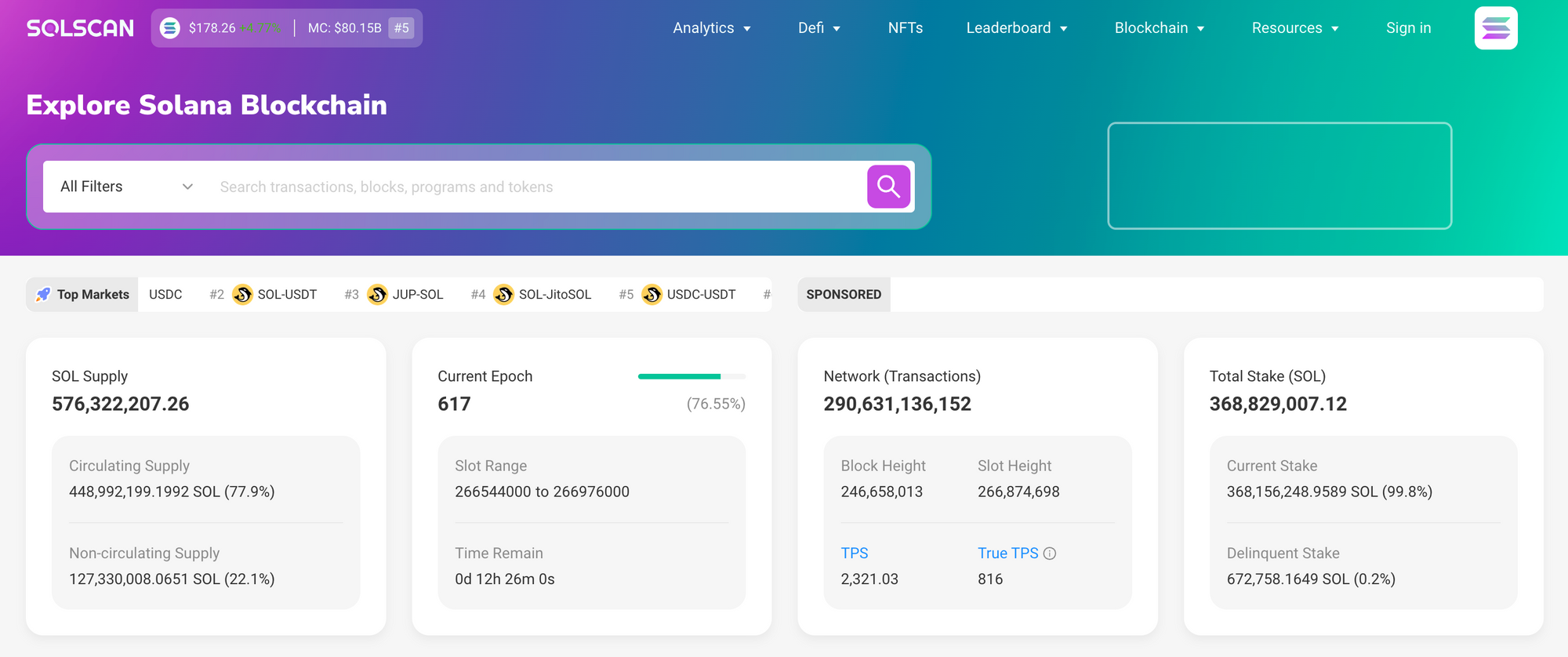
Okay, so check this out—Solana moves fast. Wow! If you’re new to on-chain sleuthing, an explorer is your map and magnifying glass. Solscan is one of the go-to tools for Solana users who want clear transaction data, token details, and quick sanity checks on addresses and program interactions. My instinct said there was more to it than pretty charts, and I was right; there’s an ecosystem of signals buried in every transaction, and knowing where to look saves you time and money.
Whoa! Searching for a wallet or mint address on Solscan is almost instinctive. Enter the address. Hit search. You get balances, token lists, and a reverse timeline of activity. Medium-sized projects usually show up with rich metadata, though smaller mints sometimes lack names or logos. Initially I thought that missing metadata meant something shady, but then realized it often just means the token isn’t registered on a central registry yet—still important to be cautious though.
Here’s the thing. Transaction details are where most people miss the nuance. Hmm… you can see signatures, block time, fee payer, and parsed instructions. Those instruction decodes matter. For example, when an NFT transfer goes through a marketplace program, you can see the program ID and the exact instruction that executed. That tells you whether funds went to a marketplace escrow or straight to a wallet. On one hand that sounds obvious—though actually, seeing the instruction list clarified a few trades that had weird fee splits for me.
Practical ways to use Solscan as your token tracker
Start with token mints. Search a mint address and check the “Token Info” section. It shows supply, decimals, and current holders. If total supply is astronomically high but the circulating supply shown differs a lot, that’s a red flag. I’m biased, but that part bugs me—many token creators hide dilution in plain sight. Double-check the mint authority. If the authority is still set to an EOA (externally owned address), pause and investigate.
Whoa! Look at the holder distribution. Large single-holder concentrations often signal centralized control. Medium sentence example here: check percent held by top 10 holders and watch for vesting schedules. Longer thought: if top wallets are associated with launchpads or team wallets but have no vesting on-chain, then tokenomics can feel fragile to outside observers, and that matters when you consider price risk and future dumps.
Another practical trick—use the transaction logs and raw data. This isn’t flashy, but it’s reliable. On the transaction page you can expand “Raw Transaction” and “Program Logs” to see runtime messages. Those logs sometimes reveal failed instructions or program-level errors that aren’t obvious from the parsed UI. Initially I overlooked logs; later I found them invaluable when diagnosing why an interaction reverted.
Really? Use the “Token Transfers” and “Transfers” tabs to trace movement over time. Small repetitive transfers often mean automated market-making or staking distributions. Large single transfers to unknown addresses could mean rug pulls or team reallocations. Oh, and by the way, watching patterns over a 24–72 hour window is often more revealing than a snapshot.
How to spot scam tokens and suspicious behavior
First rule: if something smells off, it probably is. Short sentence: trust that feeling. Medium: check mint authority, holder concentration, and recent account activity. Longer: if the token only appears recently with a big initial liquidity injection followed by multiple transfers to new wallets, assume it’s risky until proven otherwise.
My gut feeling flagged several memes early on, and then transaction history confirmed it—no lockups, many transfers to new accounts, and no verifiable team addresses. Hmm… that combo often precedes a rug. I’m not 100% sure every time, but taking a conservative stance saved me from being caught in a few fast-moving schemes.
Use Solscan’s native tools to find related addresses. The “Related Accounts” or “Top Holders” list often shows patterns—wallet clusters that participate in coordinated behaviors. You can also click into program IDs to see what other transactions hit the same program. If a suspicious swap uses a low-liquidity DEX pool repeatedly, that pool’s liquidity providers are probably complicit or uninformed.
Whoa! If you’re verifying an NFT drop, check the metadata link and hosting—on-chain or off-chain. Medium sentence: image IPFS or Arweave hashes appearing in the metadata are better signals than a centralized CDN. Longer thought: a project that hosts its assets on a personal website without a fallback is creating a single point of failure and an easy exit path for bad actors.
Power user tips: APIs, rate limits, and developer debug
Solscan offers APIs that make token tracking programmatic. Short: use the APIs for alerts. Medium: set up watchlists for mint addresses and program events to trigger notifications. Longer: polling transactions and parsing instruction types lets you automate due diligence—flagging mints with sudden supply changes, or tracking a wallet’s in/outflow in near real-time.
I’m biased toward using both public explorer views and on-chain RPC reads. Public explorers cache and index data for convenience, though they sometimes lag behind real-time RPC nodes. So when you’re debugging a time-sensitive action—like an arbitrage or a pending sweep—check both sources. Actually, wait—let me rephrase that: use the explorer for readability and the RPC for raw timing accuracy.
Watch for rate limits and API keys. Some endpoints cap requests; batching is smarter than hammering. And if you’re building a UI that surfaces token holdings, cache sensible TTLs—no need to query every second unless you really need live orderbook-level fidelity.
FAQ
Q: Is Solscan the only explorer I should trust?
A: No. Use multiple explorers and RPC endpoints for cross-checks. Solscan is polished and user-friendly, but complement it with other sources to avoid single-point mistakes.
Q: How can I verify a token isn’t a rug?
A: Look for locked liquidity, vesting schedules, decentralized holder distribution, public team identifiers, and transparent metadata. If most of those are missing, be cautious—very cautious.
Q: Where can I find Solscan’s official site?
A: You can find Solscan’s official site here, and bookmark it for quick reference.
Q: Any quick CLI or dev tips?
A: Parse base58 addresses carefully, use the RPC getConfirmedSignaturesForAddress2 and getConfirmedTransaction endpoints for sequence checks, and always handle reorgs and failed tx statuses gracefully in your tooling.
I’ll be honest—this feels like a lot, and some of it is messy. Small mistakes happen, and explorers evolve. Something felt off about how often token metadata was inconsistent last year, and that pushed me to triangulate sources more rigorously. I’m not 100% sure every heuristic will hold forever, but combining on-chain checks with a skeptical mindset reduces surprises.
So yeah—use Solscan, but don’t worship it. Use it as a fast, friendly lens into Solana’s state, then zoom with RPC and your own checks when decisions matter. Somethin’ tells me that approach will keep you safer and smarter on-chain.